Research & Innovation
From scientific questions to evidence for well engineering.
LabCim connects formulation, experimentation and interpretation to understand materials and cementitious systems under conditions representative of the well lifecycle.
Challenge-driven research
Engineering problems translated into research questions.
Research begins with the phenomenon or performance that needs to be understood, rather than with an isolated list of equipment or techniques.
Each challenge guides the research question, the selection of experimental conditions and the type of evidence required. The method follows the question under investigation.
Test results, characterization, data and interpretation become meaningful when they remain connected to the engineering context that motivated the study.
-
Challenge
Define the scientific or engineering problem.
-
Research question
Establish what needs to be understood or compared.
-
Experimentation
Select methods and conditions aligned with the question.
-
Evidence
Produce technically traceable observations and measurements.
-
Interpretation
Relate data, mechanisms and study limitations.
-
Application
Connect the knowledge produced to the engineering context.
Four R&D axes
Connected fronts built on a shared research rationale.
The axes articulate scientific domains, experimental conditions, engineering problems and digital integration while keeping their roles distinct.
-
Scientific domain
Materials and cementitious systems
Guiding question
How do composition, structure and properties relate to the required performance?
Formulation, materials development and composition-structure-property relationships guide the study of cement slurries and other cementitious systems.
-
Experimental strategy
Testing under severe conditions
Guiding question
How do pressure, temperature and chemical exposure affect the observed behavior?
Testing and exposure under representative conditions support the investigation of materials in high-pressure/high-temperature (HPHT), steam-well and geothermal contexts.
-
Engineering problem
Integrity and well lifecycle
Guiding question
Which properties and transformations matter to performance over time?
Assessment connects performance, durability and properties related to well integrity across lifecycle stages, including plugging and abandonment (P&A).
-
Cross-cutting integration
Digital technologies
Guiding question
How can data and computational methods extend interpretation and support technical decisions?
Modeling, data organization and computational tools connect experimental evidence, research and engineering without replacing scientific validation.
How we produce evidence
An experimental pathway connecting material, condition, data and interpretation.
The sequence below represents a general research rationale. Each study is configured according to its research question and application context.
-
Formulation
Definition of materials and variables relevant to the question.
-
Preparation
Controlled preparation of the sample and initial conditions.
-
Testing or exposure
Application of the experimental conditions defined for the study.
-
Characterization
Observation of relevant physical, chemical and microstructural properties.
-
Data
Recording and organization of the measurements and observations produced.
-
Interpretation
Integration of evidence, including modeling where appropriate.
Not every project follows the stages in the same way or uses the same set of methods.
Scientific and engineering contexts
The same scientific capability can address different environments and well lifecycle stages.
Contexts guide research questions and experimental conditions; they are not a list of services or predefined outcomes.
-
Oil and gas
Cementitious systems and questions related to well cementing and the well lifecycle.
-
HPHT environments
Combined effects of high pressure and high temperature on materials and measurements.
-
Steam wells
Thermal conditions and exposures representative of this operating context.
-
Geothermal wells
Materials and performance under conditions associated with geothermal wells.
-
CCUS
Interactions between cementitious systems and conditions related to geological carbon storage.
-
Integrity and lifecycle
Properties relevant to long-term performance and well integrity.
-
Plugging and abandonment (P&A)
Materials and integrity questions associated with the end of the well lifecycle.
Research in action
Experimental operation is part of an evidence chain.
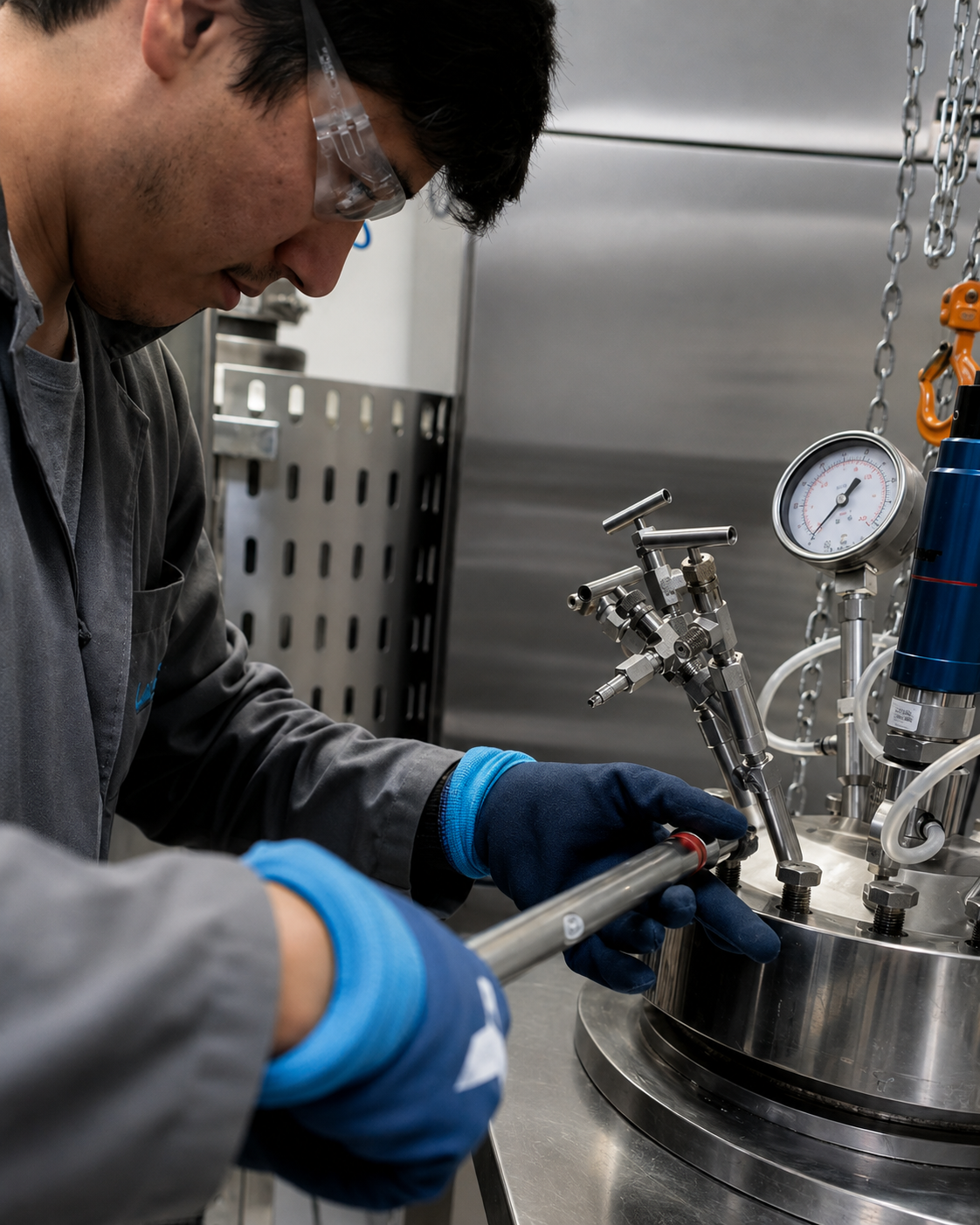
In studies under severe conditions, preparation, execution, parameter control and data recording need to remain connected to the research question.
Work with an HPHT system illustrates the interaction among people, procedures and instrumentation. Equipment is a means to investigate material behavior under the conditions defined by the study.
From evidence to research outputs
Knowledge that develops into different forms of contribution.
Scientific investigation can support academic output, technological development and the application of evidence to new research and well engineering problems.
-
Scientific knowledge
Understanding relationships among materials, conditions and performance.
-
Publications
Scientific communication of authorized methods, analyses and results.
-
Technology development
Advancement of materials, methods and research approaches.
-
Tools
Computational resources for data, modeling and technical support.
-
Projects
Research and R&D structures focused on scientific and technological questions.
-
Application of evidence
Connections between scientific interpretation and well engineering contexts.
Continue exploring
Explore LabCim's experimental resources and scientific output.
The research rationale relies on specific capabilities and leads to scientific outputs.