
Infrastructure & Capabilities
From materials preparation to experimental evidence generation.
LabCim integrates preparation, testing and characterization to investigate cementitious systems under conditions relevant to engineering and the well lifecycle.
Capability-driven infrastructure
Experimental resources organized around what needs to be understood.
Infrastructure becomes meaningful when it is connected to a scientific question, an appropriate method and the evidence that a study needs to generate.
Capabilities therefore come before instruments. Equipment supports an investigation, but it does not replace the definition of the problem, experimental conditions and interpretation criteria.
This rationale connects materials, testing and characterization in a sequence guided by the experimental question and the evidence required.
-
Capability
Defines what can be prepared, measured, characterized or assessed.
-
Method or test
Establishes how the experimental question will be investigated.
-
Infrastructure
Supports the controlled execution of the selected method.
-
Evidence
Generates observations and measurements for analysis and interpretation.
-
Application
Relates evidence to questions of performance, well integrity and well lifecycle.
From material to initial behavior
Preparing systems and understanding fresh-state behavior.
The first stages establish composition, preparation and cement slurry behavior before hardening.
-
Preparation and formulation
Capability
Prepare well cement slurries and samples in line with the experimental question and subsequent stages of the study.
Methods and measurements
- Well cement slurry formulation
- Sample homogenization and preparation
- Cementitious system development
Why it matters
Controlled composition and preparation provide the basis for comparing the behavior of the materials under investigation.
-
Fresh-state behavior
Capability
Assess how cement slurries behave before hardening under conditions relevant to the study.
Methods and measurements
- Rheology
- Thickening time
- Fluid loss
- Free water
Why it matters
These measurements support the interpretation of slurry behavior during critical stages of well cementing.
Severe conditions
Testing under high pressure and high temperature.
Representative well conditions make it possible to investigate cementitious systems in contexts that cannot be assessed solely under conventional laboratory conditions.
Core capability
Subject materials to controlled tests and exposures under severe conditions defined by the experimental question.
Investigation contexts
- High-pressure/high-temperature (HPHT)
- Representative well conditions
- Controlled exposure
- CO₂ exposure
Evidence generated
Measurements of material behavior under the conditions established in the experimental design, without extrapolating beyond the scope of the study.
After hardening
Material properties, transport and characterization.
Complementary measurements help relate hardened-material behavior to composition and microstructure.
-
Mechanical and transport properties
Capability
Assess properties associated with the performance of hardened cementitious systems.
Methods and measurements
- Compressive strength
- Permeability
- Porosity
Evidence for interpretation
The measurements provide evidence on strength and transport for the materials and conditions actually investigated.
-
Physico-chemical and microstructural characterization
Capability
Relate composition, structure and microstructure to experimentally observed properties.
Methods and measurements
- Physico-chemical characterization
- Microstructural characterization
- Integration of evidence across scales
Evidence for interpretation
The data support interpretation of composition-structure-property-performance relationships.
Multiscale characterization
From the materials scale to well performance.
Evidence obtained across different scales can be integrated to understand how material characteristics relate to properties and well integrity questions.
- Composition and structure
- Microstructure
- Properties
- Performance
- Well integrity
Integrity and lifecycle
Evidence connected to cementitious system performance.
Well integrity assessment brings together properties, exposure conditions and transformations relevant to the well lifecycle.
This integration connects laboratory observations to engineering questions involving cement sheath integrity, long-term performance and, when relevant, plugging and abandonment (P&A).
- Cementitious systems
- Representative conditions
- Long-term performance
- Well integrity

Infrastructure in operation
A functional environment for rigorous evidence generation.
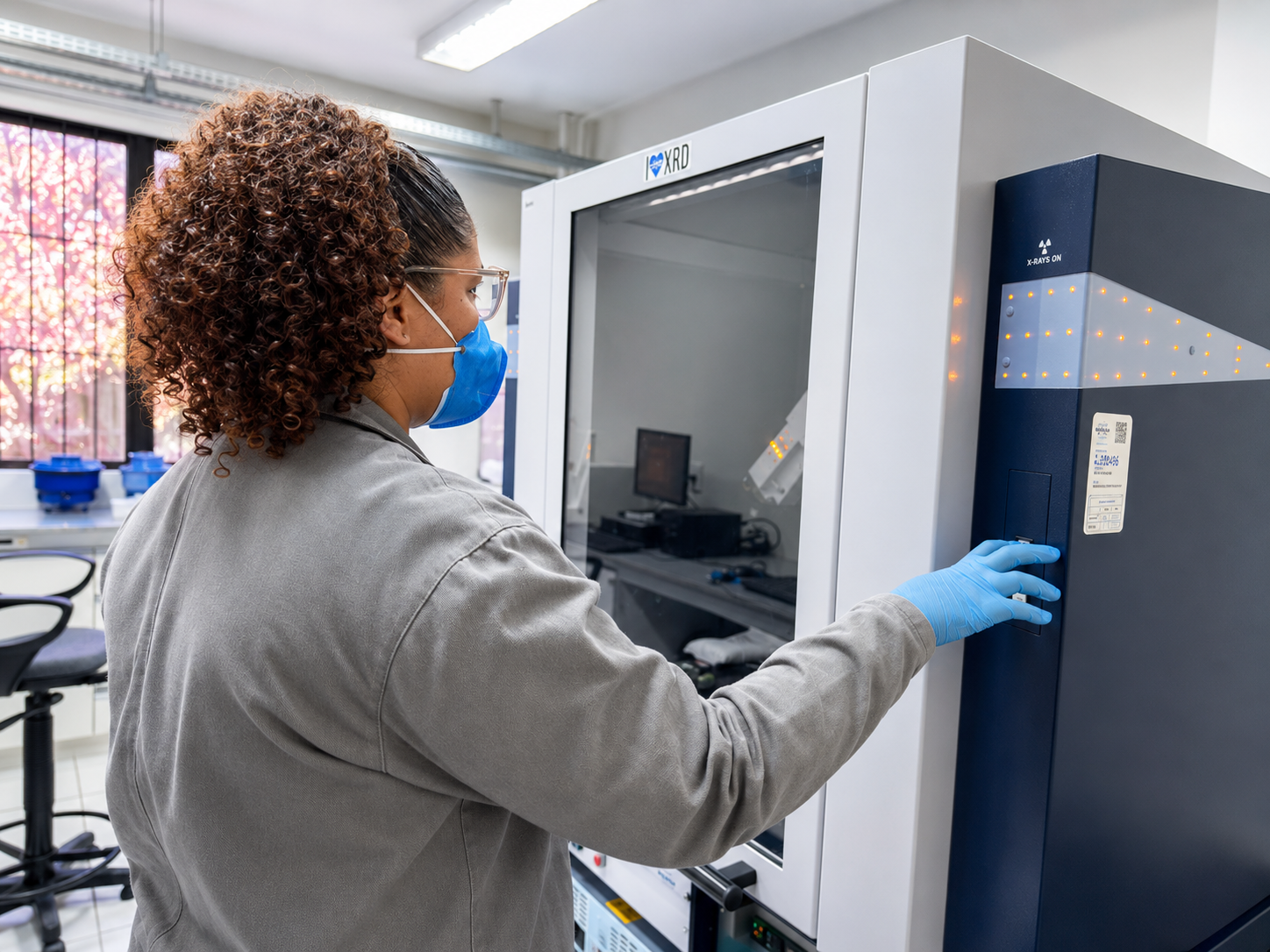
Infrastructure is mobilized as part of a process that combines preparation, experimental procedures, technical operation and interpretation.
Each physical resource serves a function within the study design. The operational scene shows the interaction among personnel, sample and instrumentation without presenting equipment as an isolated protagonist.
Connections
Capabilities that support research and cooperation.
Explore how this infrastructure connects to Research & Innovation or contact LabCim.